Visiting traditional sacred spots is an unforgettable highlight of traveling in Japan. Walking through a quiet forest to a Shinto shrine or breathing in the incense of a Buddhist temple offers a deep sense of peace. However, many international visitors find themselves asking: “Is this a shrine or a temple?”, “What do these rituals actually mean?”, and “Am I doing this correctly or accidentally being disrespectful?”
This comprehensive, step-by-step guide will clear up the historical differences, teach you how to worship with beautiful, authentic manners, explain the hidden spiritual reasons behind every movement, and introduce you to Japan’s amazing traditional stamp-collecting culture. Bookmark this page so you can check it on your phone during your next trip to Japan!
⛩️ Part 1: What’s the Deep Difference? (Shrine vs. Temple)
Before you step through the gates, it helps to know where you are. Shrines and temples look similar at first glance—both feature traditional wooden architecture, beautiful gardens, and historical structures—but they belong to entirely different spiritual traditions, histories, and mindsets.
🔴 Shinto Shrines (神社 – Jinja / Jingu)
Shrines belong to Shinto, Japan’s indigenous, nature-based spirituality that dates back to prehistoric times. Shinto does not have a single founder or a holy book like the Bible. Instead, it teaches that divine spirits (kami) reside in all things—mountains, rivers, ancient trees, storms, and even historical figures who did great deeds.
- How to spot them: Look for a massive, iconic “Torii” gate at the entrance. The Torii marks the strict boundary between the everyday human world and the sacred realm of the spirits. Shrines are usually surrounded by dense, natural forests (Chinju-no-mori).
- The Core Mindset: A shrine is a place to greet the local spirits, make a request or prayer for good fortune (Kigan), and express gratitude for nature’s blessings and daily life. You are visiting the “home” of the local guardian deity.
🟢 Buddhist Temples (お寺 – Otera / Ji)
Temples belong to Buddhism, a philosophy and religion founded in India by Siddhartha Gautama (Buddha). Buddhism was brought to Japan from mainland Asia (via China and the Korean Peninsula) in the 6th century.
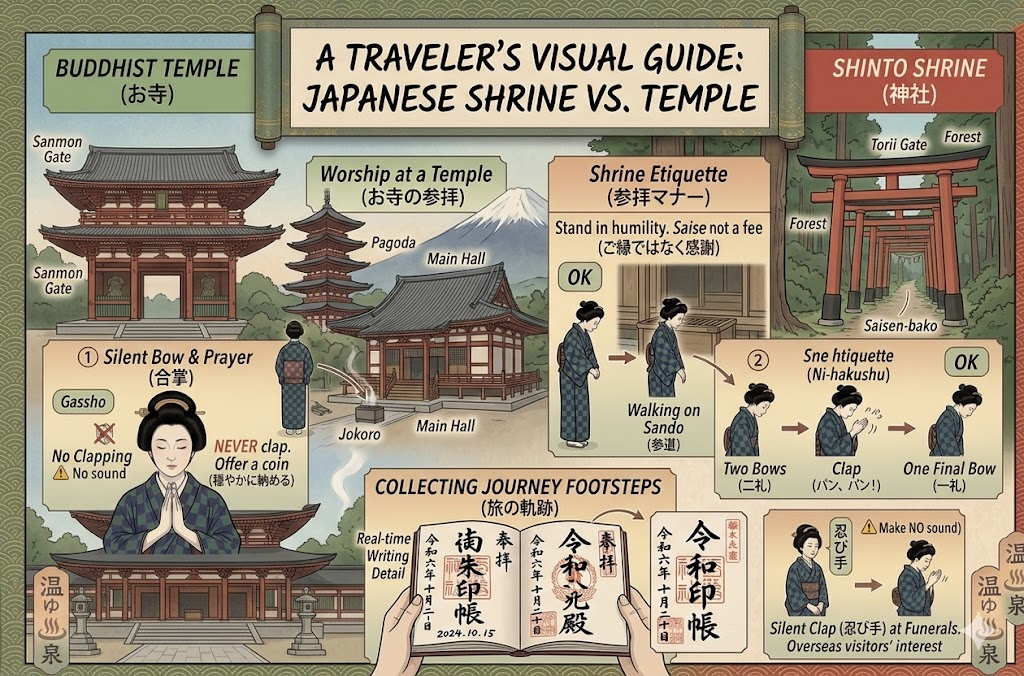
- How to spot them: Look for a large, roofed wooden entrance gate called a “Sanmon”. These gates are often grand, multi-story buildings and house fierce, muscular guardian statues called Nio (Wrathful Deities) to keep evil spirits away. On temple grounds, you will also typically find burning incense, cemeteries, and towering three- or five-story pagodas (To), which store sacred relics.
- The Core Mindset: A temple is a place of self-reflection. Instead of asking an external god to grant a wish, you stand before Buddha (or a Bodhisattva like Kannon) to look within your own heart, reflect on your actions, and make a personal vow (Chikai) about how you will improve yourself and live a compassionate life. It is also a place to pray for ancestors and the deceased.
🚶♂️ Part 2: Step-by-Step Shrine Etiquette (From Gate to Altar)
To show proper respect to the local deities and experience the ritual with the elegance of a local, follow these detailed, traditional steps when visiting a Shinto shrine.
[Phase 1: Entering the Sacred Realm]
Step 1: The First Bow at the Torii Gate
Think of the Torii gate as the front door to a deity’s home. Before you step underneath it:
- Stop completely and face the shrine.
- Remove your hat and sunglasses (this is a universal sign of respect in Japan).
- Give a gentle, deep bow (about 30 to 45 degrees).
- Step through. Tip: It is a local custom to step through with the foot closest to the outer edge of the gate, avoiding stepping directly on the raised wooden threshold.
When your visit is over and you pass back through the gate to return to the city, turn around, face the shrine one last time, and give a final bow of gratitude.
Step 2: Walking on the Path (Stay to the Sides!)
As you walk along the gravel pathway (Sando) leading toward the main hall, stay clearly to the left or right sides.
- The Secret Rule: The exact center of the path is called “Seichu” (the spiritual center) and is considered the pathway reserved exclusively for the deities to travel. Walking right down the middle is seen as a lack of humility.
💡 A Fun Fact: Left or Right? The Wisdom of Ise Jingu Depending on the shrine, the specific side you should walk on might change. At Ise Jingu—the most spiritually significant shrine complex in Japan—visitors are asked to walk on the left side at the Geku (Outer Shrine) and on the right side at the Naiku (Inner Shrine). This is not random! It is designed so that you walk on the side that leads you directly and naturally to the water purification pavilion, showing deep consideration for the environment.
[Phase 2: Purifying Your Mind and Body]
Step 3: Cleansing at the Water Pavilion (手水 – Temizu)
Before approaching the main altar, you must wash away the physical and spiritual impurities of the outside world at the stone water pavilion (Temizuya).
The ultimate sign of a pro-traveler is completing this entire multi-step ritual using only a single scoop of water without ever dipping the ladle back into the stone basin. Work efficiently and don’t waste water:
- Wash your left hand: Pick up the wooden ladle with your right hand, scoop a generous amount of water, and pour a small amount over your left hand.
- Wash your right hand: Switch the ladle to your left hand and pour water over your right hand.
- Rinse your mouth: Switch the ladle back to your right hand. Pour some water into your cupped left palm, and bring that water to your mouth to gently rinse and spit out into the drainage area beside the basin. (Crucial Note: For hygiene and etiquette reasons, never bring the ladle directly to your mouth!)
- Wash your left hand again: Since your left hand touched your mouth, pour a little water over it one final time to clean it.
- Clean the ladle for the next person: Tilt the ladle completely vertical so the remaining water runs down the handle, washing away the oils from your hands. Place the ladle face down on the rack.
[Phase 3: Praying to the Deities]
Step 4: At the Main Hall (二礼二拍手一礼 – The Golden Rule)
Approach the altar quietly. If there is a line, wait patiently. When it is your turn, step forward and bow slightly.
1. Offering a Coin (Saisen)
Gently slide your coin into the wooden offering box (Saisen-bako). Do not throw or toss it aggressively, as it is an offering of respect.
💡 The True Meaning of Coin Offerings (It’s Not a Payment!) You will often hear travelers say, “You must use a 5-yen coin because it sounds like Go-en (good fortune)!” While this is a beautiful and popular wordplay, the original meaning of Saisen is deeper. Historically, people offered valuable raw rice or money wrapped in clean white paper to thank the deities for protecting their families and ensuring a successful harvest. Your offering is not a “fee” to buy a miracle; it is an expression of gratitude for your current life. If you don’t have a 5-yen coin, any coin (10, 50, 100, or 500 yen) is perfectly fine and respected.
2. Ringing the Bell
If there is a thick rope connected to a massive brass bell hanging above the box, give it a firm, steady tug to ring it once or twice. This sound is believed to clear away evil energy and wake up/greet the local deity.
3. The Ritual: Two Bows, Two Claps, One Bow
- Two Bows (二礼 – Ni-rei): Stand tall, smooth your clothes, and bend deeply from your waist twice into a 90-degree angle. Hold each bow for a moment.
- Two Claps (二拍手 – Ni-hakushu): Bring your hands together in front of your chest. Slide your right hand slightly downward so that your right fingertips align with the first joint of your left fingers. Open your hands slightly and clap twice firmly and clearly (Pan, Pan!).
- Why slide the hand? In Japanese culture, the left hand represents the divine/spirit, and the right hand represents the human. Sliding the right hand down shows humility before the divine. Furthermore, it creates a beautifully hollow, crisp sound that echoes through the shrine.
- The Prayer: Slide your right hand back up into perfect alignment so your fingertips match. Close your eyes, bow your head slightly, and offer your silent prayer.
- What to pray for: Instead of listing selfish demands (like “make me rich”), start by introducing yourself silently (“I have come from [Your Country]”). Then, express gratitude (“Thank you for allowing me to visit safely”) before making your wish.
- One Bow (一礼 – Ichi-rei): Lower your hands to your sides, and finish the prayer with one final deep, 90-degree bow. Step back a few inches, give a small nod, and quietly step away.
💡 Pro-Tip: The Hidden Cultural Message Behind the “Clap”
In Shinto traditions, there is a very delicate, beautiful etiquette where the sound of the clap is completely removed depending on the situation.
- During Worship (Shrines): You clap firmly and loudly to create a bright energy that communicates with the deities.
- During Funerals (Shinto Style / 神葬祭 – Shinso-sai): To express deep sorrow and utmost respect for the deceased, you bring your hands together but stop just before they touch, making absolutely no sound at all. This gesture is called “Shinobite” (忍び手 – Silent Clap).
This deliberate contrast between “making sound to celebrate life” and “silencing the sound to mourn” beautifully reflects the profound consideration, empathy, and emotional depth embedded in Japanese manners.
⚠️ CRITICAL TEMPLE DIFFERENCE: NEVER CLAP AT A TEMPLE!
If you are praying at a Buddhist Temple, the rules change entirely. Clapping your hands at a temple is considered a major cultural mistake, as it disturbs the quiet meditation of the temple.
Follow this separate routine at a temple’s main altar:
- Purify with Incense (常香炉 – Jokoro): In the main courtyard, you will often see a large bronze burner filled with smoking incense. Buy a bundle if available, light it, and place it inside. Then, use your hands to gently cup the fragrant smoke and draw it toward your body. If you pull it toward your head, it is believed to grant wisdom; toward a sore arm or leg, it is believed to bring healing and purification.
- Offer your coin quietly: Slide your coin into the box gently.
- Bow and Pray in Silence (合掌 – Gassho): Bring your palms flat together in front of your chest with your fingers pointing upward. This is called Gassho. Do not slide your hand down, and do not clap. Close your eyes, bow your head slightly, and offer your silent vow or prayer to Buddha.
- Final Bow: When finished, simply bow slightly and step away quietly.
📖 Part 3: Collecting the Footsteps of Your Journey (Goshuin & Goshuin-cho)
Once you have completed your prayers, you are ready to participate in one of Japan’s most beautiful, artistic, and deeply respected travel traditions: collecting sacred commemorative seals.
These are entirely different from casual tourist ink stamps found at train stations or museums. They are powerful, hand-written calligraphic blessings created right in front of you.
📕 Your Personal Art Diary: The “Goshuin-cho”
To collect these seals, you must purchase a dedicated accordion-style book called a Goshuin-cho (御朱印帳 – Stamp Book). Priests and monks consider regular notebooks, loose paper, or tourist scrapbooks to be highly disrespectful and will refuse to write in them.
When you present your Goshuin-cho at the stamp office (Shukushodokoro or Goshuin-jo), a trained scribe, priest, or monk will use a traditional brush and dark ink to elegantly write:
- The name of the shrine or temple.
- The specific deity or main hall being honored.
- The exact date of your visit.
- They will then press large, highly intricate vermilion (red) stamps over the calligraphy.
Because every single scribe has a different handwriting style and every spiritual spot has a unique layout, your Goshuin-cho transforms into a stunning, one-of-a-kind art piece and a physical diary of your spiritual footsteps across Japan. You can purchase these books (which feature beautiful fabric covers ranging from traditional silk to modern anime designs) at major shrines, temples, or stationery shops for around 1,500 to 2,500 yen.
💭 A Note from the Author Recently, whenever I visit shrines and temples across Japan, I see so many international travelers holding their precious Goshuin-cho books, waiting patiently in line at the stamp office! Seeing Japan’s traditional culture, calligraphy, and sacred manners being so deeply appreciated and loved by visitors from all over the world always brings a warm smile to my face. It shows that travel truly connects our hearts.
🏯 Expanding Stamp Traditions: Gojoin & Goshoin
Following the massive global popularity of Goshuin, other beautiful commemorative stamps have emerged for different types of journeys:
- Gojoin (御城印): Stunning commemorative stamps printed on special paper that you can collect when exploring historical Japanese castles (like Himeji or Osaka Castle).
- Goshoin (御翔印): Limited-edition stamps available at various Japanese airports, allowing aviation fans to map out their flights and travel journeys across the Japanese archipelago.
The Golden Rule: Pray First, Stamp Second
Always remember the golden rule of this culture: “Pray first, stamp second” (まずお参り、それから御朱印). A Goshuin is a sacred proof of your spiritual connection and visit to the deity or temple, not a casual souvenir item. Walking straight to the stamp office upon entering the grounds without visiting the main hall to pray is considered incredibly rude. Always complete your steps at the main hall before heading to get your book signed.
❓ Frequently Asked Questions (Worship Q&A)
Q: Can I take photos inside a shrine or temple? A: Generally, photography in the outdoor courtyards, gardens, and pathways is completely fine. However, taking photos directly into the main altar hall or filming the statues inside is strictly prohibited at almost all locations. Look for signs that say “No Photography” (撮影禁止) and always respect the privacy of people who are praying.
Q: Is it okay to visit a shrine if I am not Shinto or Buddhist? A: Yes! Shrines and temples warmly welcome people of all faiths, backgrounds, and nationalities. Practicing the bows and purification rituals is seen as a wonderful sign of respect to Japanese culture, not a forced conversion to a religion.
Q: How much money should I put in the offering box? A: There is no fixed amount. Most locals offer a single coin—typically a 5-yen, 10-yen, or 100-yen coin. The intention and respect in your heart matter infinitely more than the amount of money you offer.
🗣️ Useful Japanese Phrases for Your Visit
Here are a few polite phrases you can use when interacting with staff at the shrine or temple:
- “Goshuin をいただけますか?” (Goshuin wo itadakemasu ka?) — Could I please receive a Goshuin?
- “Goshuin-cho はどこで買えますか?” (Goshuin-cho wa doko de kaemasu ka?) — Where can I purchase a Goshuin-cho book?
- “料金はいくらですか?” (Ryokin wa ikura desu ka?) — How much is the fee? (Note: Goshuin usually cost between 300 to 500 yen per page, though some special editions can be 1,000 yen).
✨ Embrace the Spiritual Journey
Taking the time to slow down, bow at the gates, listen to the rustling trees, and practice these timeless rituals will completely transform your travel experience in Japan. You won’t just be looking at history through a camera lens—you will be actively participating in a living culture that has survived for over a thousand years.
Bring your beautiful Goshuin-cho, show wonderful respect to the local paths, and enjoy a deeply moving, unforgettable spiritual journey through the heart of Japan!